
SSH2FA 在保持双因素认证的安全性的同时,提供了类似扫码的便捷体验, 适用于个人/小团体使用
SSH2FA ssh实现自定义API服务器二次登录验证
10 mins
1979 words
Loading views
服务器 SSH 登录的安全性,我实现了 SSH2FA,在保持双因素认证的安全性的同时,提供了类似扫码的便捷体验, 适用于个人/小团体使用
核心功能h3
- Web 审批:登录时终端输出一个链接,点击后在浏览器确认即可放行。
- 断网降级:若无法连接认证服务器,自动回退到传统 TOTP 验证,确保不被锁在门外。
url认证

认证服务器失联TOPT

实现思路h3
- 使用
sshd_config的ForceCommand在登录成功后先运行自定义程序,验证通过后再启动用户的 Shell。 - 项目分为两部分:
- Auth Server (Python):提供
/start_login、/check_status、/approve接口,管理登录会话。 - Client (Go):编译为单文件二进制,负责请求审批链接、轮询状态以及离线 TOTP 验证。
- Auth Server (Python):提供
代码实现h2
1. Auth Server (Python)h3
#!/data/miniforge3/bin/python3from flask import Flask, request, jsonifyimport uuidimport timeimport threading
app = Flask(__name__)
# 内存存储:# tokens: {session_token: {"status": "pending/approved/rejected", "username": "root", "display_token": "xxx", "ts": 12345}}# display_to_session: {display_token: session_token}# 生产环境建议用 Redistokens = {}display_to_session = {}
def cleanup_tokens():    """定期清理过期 Token"""    while True:        now = time.time()        expired = [t for t, v in tokens.items() if now - v['ts'] > 300]        for t in expired:            # 清理 display_to_session 映射            display_token = tokens[t].get('display_token')            if display_token and display_token in display_to_session:                del display_to_session[display_token]            del tokens[t]        time.sleep(60)
threading.Thread(target=cleanup_tokens, daemon=True).start()
@app.route('/start_login', methods=['POST'])def start_login():    data = request.json    username = data.get('username')
    # 生成两个独立的 token    session_token = str(uuid.uuid4())  # 客户端用于轮询 (私密)    display_token = str(uuid.uuid4())  # 用户看到的批准链接 (公开)
    tokens[session_token] = {        "status": "pending",        "username": username,        "display_token": display_token,        "ts": time.time()    }
    # 建立 display_token -> session_token 的映射    display_to_session[display_token] = session_token
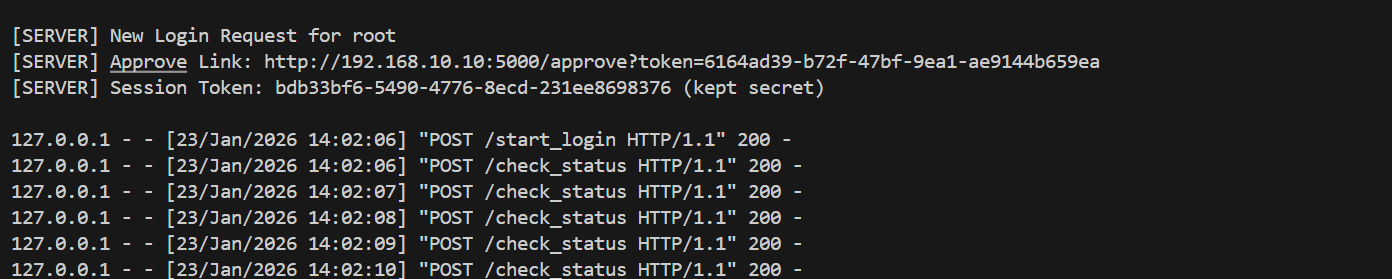
    # 这里模拟把链接打印到服务器日志,实际场景你可以把这个链接发短信/钉钉给管理员    print(f"\n[SERVER] New Login Request for {username}")    print(f"[SERVER] Approve Link: http://192.168.10.10:5000/approve?token={display_token}")    print(f"[SERVER] Session Token: {session_token} (kept secret)\n")
    return jsonify({        "success": True,        "session_token": session_token,        "display_token": display_token    })
@app.route('/check_status', methods=['POST'])def check_status():    data = request.json    token = data.get('token')    if token not in tokens:        return jsonify({"status": "expired"})    return jsonify({"status": tokens[token]["status"]})
@app.route('/approve', methods=['GET'])def approve():    display_token = request.args.get('token')
    # 通过 display_token 找到对应的 session_token    session_token = display_to_session.get(display_token)
    if session_token and session_token in tokens:        tokens[session_token]['status'] = 'approved'        username = tokens[session_token]['username']        print(f"[SERVER] ✅ Login APPROVED for {username}")        return "<h1>Login APPROVED! You can close this window.</h1>"
    return "<h1>Token Invalid or Expired</h1>", 404
@app.route('/reject', methods=['GET'])def reject():    display_token = request.args.get('token')
    # 通过 display_token 找到对应的 session_token    session_token = display_to_session.get(display_token)
    if session_token and session_token in tokens:        tokens[session_token]['status'] = 'rejected'        username = tokens[session_token]['username']        print(f"[SERVER] ❌ Login REJECTED for {username}")        return "<h1>Login REJECTED.</h1>"
    return "<h1>Token Invalid or Expired</h1>", 404
if __name__ == '__main__':    # 监听 0.0.0.0 方便你从手机/浏览器访问    app.run(host='0.0.0.0', port=5000)
2. Client (Go)h3
package main
import (  "bufio"  "bytes"  "encoding/json"  "flag"  "fmt"  "io"  "net/http"  "os"  "os/exec"  "strings"  "syscall"  "time"
  "github.com/pquerna/otp/totp")
// ================= Configuration =================
// const (//   // Backend API address//   APIHost = "http://127.0.0.1:5000"
//   // Enable 2FA for non-interactive connections (SCP, SFTP, Git, rsync, etc.)//   // true  = These commands must also perform 2FA authentication//   // false = These commands bypass authentication (recommended for better UX)//   EnableNonInteractive2FA = true
//   // Authentication timeout (seconds)//   AuthTimeout = 60
//   // Status polling interval (seconds)//   PollInterval = 2// )
// =================================================
// SessionType represents the type of SSH sessiontype SessionType string
const (  Interactive    SessionType = "interactive"  NonInteractive SessionType = "non-interactive")
// StartLoginRequest represents the request to start logintype StartLoginRequest struct {  Username string `json:"username"`}
// StartLoginResponse represents the response from start_logintype StartLoginResponse struct {  Success      bool   `json:"success"`  SessionToken string `json:"session_token"` // 私密,用于轮询  DisplayToken string `json:"display_token"` // 公开,显示给用户}
// CheckStatusRequest represents the request to check statustype CheckStatusRequest struct {  Token string `json:"token"`}
// CheckStatusResponse represents the response from check_statustype CheckStatusResponse struct {  Status string `json:"status"` // "pending", "approved", "rejected"}
// getSessionType determines if this is an interactive or non-interactive sessionfunc getSessionType() (SessionType, string) {  cmd := os.Getenv("SSH_ORIGINAL_COMMAND")  if cmd != "" {    return NonInteractive, cmd  }  return Interactive, ""}
// getUsername retrieves the current username from environmentfunc getUsername() string {  if user := os.Getenv("PAM_USER"); user != "" {    return user  }  if user := os.Getenv("USER"); user != "" {    return user  }  return "unknown"}
// httpPost sends a POST request with JSON datafunc httpPost(url string, data interface{}) (map[string]interface{}, error) {  jsonData, err := json.Marshal(data)  if err != nil {    return nil, err  }
  client := &http.Client{Timeout: 5 * time.Second}  resp, err := client.Post(url, "application/json", bytes.NewBuffer(jsonData))  if err != nil {    return nil, err  }  defer resp.Body.Close()
  body, err := io.ReadAll(resp.Body)  if err != nil {    return nil, err  }
  var result map[string]interface{}  if err := json.Unmarshal(body, &result); err != nil {    return nil, err  }
  return result, nil}
// readTOTPSecret reads the TOTP secret for a given username from the secrets filefunc readTOTPSecret(username, secretsFile string) (string, error) {  file, err := os.Open(secretsFile)  if err != nil {    return "", fmt.Errorf("cannot open TOTP secrets file: %w", err)  }  defer file.Close()
  scanner := bufio.NewScanner(file)  for scanner.Scan() {    line := strings.TrimSpace(scanner.Text())    if line == "" || strings.HasPrefix(line, "#") {      continue    }
    parts := strings.SplitN(line, ":", 2)    if len(parts) == 2 && parts[0] == username {      return strings.TrimSpace(parts[1]), nil    }  }
  if err := scanner.Err(); err != nil {    return "", fmt.Errorf("error reading secrets file: %w", err)  }
  return "", fmt.Errorf("no TOTP secret found for user: %s", username)}
// promptTOTPCode prompts the user to enter their TOTP codefunc promptTOTPCode(username string) (string, error) {  fmt.Println()  fmt.Println("---------------------------------------------")  fmt.Printf("SERVER UNREACHABLE - OFFLINE MODE\n")  fmt.Printf("TOTP VERIFICATION FOR: %s\n", username)  fmt.Println("---------------------------------------------")  fmt.Print("Enter TOTP code from your authenticator app: ")
  reader := bufio.NewReader(os.Stdin)  code, err := reader.ReadString('\n')  if err != nil {    return "", err  }
  return strings.TrimSpace(code), nil}
// performTOTPAuth handles offline TOTP authenticationfunc performTOTPAuth(username, secretsFile string, sessionType SessionType) (bool, error) {  // Read TOTP secret for user  secret, err := readTOTPSecret(username, secretsFile)  if err != nil {    return false, err  }
  // For non-interactive sessions, we cannot prompt for TOTP  if sessionType == NonInteractive {    return false, fmt.Errorf("TOTP authentication not available for non-interactive sessions")  }
  // Prompt user for TOTP code  code, err := promptTOTPCode(username)  if err != nil {    return false, fmt.Errorf("failed to read TOTP code: %w", err)  }
  // Validate TOTP code with time skew tolerance  valid := totp.Validate(code, secret)  if !valid {    return false, fmt.Errorf("invalid TOTP code")  }
  fmt.Println("Access Granted.")  return true, nil}
// performAuth handles the complete 2FA authentication flow with TOTP fallbackfunc performAuth(username string, sessionType SessionType, pollInterval int, timeout int, apiHost string, enableTOTPFallback bool, totpSecretsFile string) (bool, error) {  startURL := fmt.Sprintf("%s/start_login", apiHost)  checkURL := fmt.Sprintf("%s/check_status", apiHost)
  // 1. Request login tokens  resp, err := httpPost(startURL, StartLoginRequest{Username: username})  if err != nil {    // Server unreachable - try TOTP fallback if enabled    if enableTOTPFallback {      fmt.Fprintf(os.Stderr, "Warning: 2FA server unreachable, falling back to TOTP authentication\n")      return performTOTPAuth(username, totpSecretsFile, sessionType)    }    return false, fmt.Errorf("2FA Service Unreachable: %w", err)  }
  success, ok := resp["success"].(bool)  if !ok || !success {    return false, fmt.Errorf("failed to start login session")  }
  // 提取两个 token  sessionToken, ok := resp["session_token"].(string)  if !ok || sessionToken == "" {    return false, fmt.Errorf("invalid session_token received")  }
  displayToken, ok := resp["display_token"].(string)  if !ok || displayToken == "" {    return false, fmt.Errorf("invalid display_token received")  }
  // 使用 display_token 构建批准链接 (公开给用户)  authLink := fmt.Sprintf("%s/approve?token=%s", apiHost, displayToken)
  // 2. Display prompt based on session type  if sessionType == Interactive {    // Interactive SSH: Display formatted prompt    fmt.Println()    fmt.Println("---------------------------------------------")    fmt.Printf("SECURITY CHECK FOR: %s\n", username)    fmt.Println("---------------------------------------------")    fmt.Print("Waiting for approval..\n\n")  } else {    // Non-interactive: Minimal output to stderr    fmt.Fprintf(os.Stderr, "2FA Required. Approve at: %s\n", authLink)  }
  // 3. Poll for approval status (使用 session_token,私密)  maxAttempts := timeout / pollInterval  for i := 0; i < maxAttempts; i++ {    statusResp, err := httpPost(checkURL, CheckStatusRequest{Token: sessionToken})    if err == nil {      if status, ok := statusResp["status"].(string); ok {        switch status {        case "approved":          if sessionType == Interactive {            fmt.Println("Access Granted.")          }          return true, nil        case "rejected":          return false, fmt.Errorf("access denied")        }      }    }    time.Sleep(time.Duration(pollInterval) * time.Second)  }
  return false, fmt.Errorf("2FA timeout")}
// executeCommand executes the original SSH command or starts a shellfunc executeCommand(originalCmd string) error {  if originalCmd != "" {    // Execute the original command    cmd := exec.Command("sh", "-c", originalCmd)    cmd.Stdin = os.Stdin    cmd.Stdout = os.Stdout    cmd.Stderr = os.Stderr    return cmd.Run()  }
  // Start interactive shell  shell := os.Getenv("SHELL")  if shell == "" {    shell = "/bin/bash"  }
  // Use syscall.Exec to replace current process with shell  return syscall.Exec(shell, []string{"-l"}, os.Environ())}
func main() {

  apiHost := flag.String("apiHost", "http://127.0.0.1:5000", "API host")  timeout := flag.Int("timeout", 30, "Timeout in seconds")  pollInterval := flag.Int("pollInterval", 1, "Poll interval in seconds")  enableNonInteractive2FA := flag.Bool("enableNonInteractive2FA", false, "Enable 2FA for non-interactive sessions")  totpSecretsFile := flag.String("totpSecretsFile", "/etc/ssh2fa/totp_secrets", "Path to TOTP secrets file")  enableTOTPFallback := flag.Bool("enableTOTPFallback", true, "Enable TOTP fallback when server is unreachable")  flag.Parse()
  // Ensure we exit with error code on any panic (security-first)  defer func() {    if r := recover(); r != nil {      fmt.Fprintf(os.Stderr, "Error: %v\n", r)      os.Exit(1)    }  }()
  username := getUsername()  sessionType, originalCmd := getSessionType()
  // === Policy Decision ===  if sessionType == NonInteractive && !*enableNonInteractive2FA {    // Bypass 2FA for non-interactive sessions if disabled    // Uncomment for debugging:    // fmt.Fprintf(os.Stderr, "DEBUG: Skipping 2FA for command: %s\n", originalCmd)    if err := executeCommand(originalCmd); err != nil {      os.Exit(1)    }    os.Exit(0)  }
  // === Perform Authentication ===  success, err := performAuth(username, sessionType, *pollInterval, *timeout, *apiHost, *enableTOTPFallback, *totpSecretsFile)  if !success {    if err != nil {      fmt.Fprintf(os.Stderr, "\n❌ %s\n", err.Error())    } else {      fmt.Fprintf(os.Stderr, "\n❌ Authentication failed\n")    }    os.Exit(1)  }
// === Execute Command After Successful Auth === if err := executeCommand(originalCmd); err != nil { fmt.Fprintf(os.Stderr, "Error executing command: %v\n", err) os.Exit(1) }}使用指南h2
- 编译客户端
Terminal window go mod init ssh2fago get github.com/pquerna/otp/totpgo build -o ssh2fa ssh2fa.gosudo mv ssh2fa /usr/local/bin/ - 配置离线 TOTP 密钥
Terminal window sudo mkdir -p /etc/ssh2faecho "root:JBSWY3DPEHPK3PXP" | sudo tee /etc/ssh2fa/totp_secretssudo chmod 600 /etc/ssh2fa/totp_secrets - 修改
sshd_config
ForceCommand /root/project/ssh2fa/ssh2fa -apiHost http://127.0.0.1:5000 -enableNonInteractive2FA true -pollInterval 1 -timeout 240重启 SSH 服务:systemctl restart sshd。
实际体验h2
- 登录时终端输出审批链接,点击后即放行。
- 若 Auth Server 不可用,系统提示离线模式并要求输入 TOTP,仍可正常登录。
这套方案在实际使用中提升了体验,同时保持了安全性,欢迎自行部署并根据需求改进。
⚠️ 无法连接认证服务器 - 启用离线模式
这时候输入之前的 TOTP 码,照样能进。